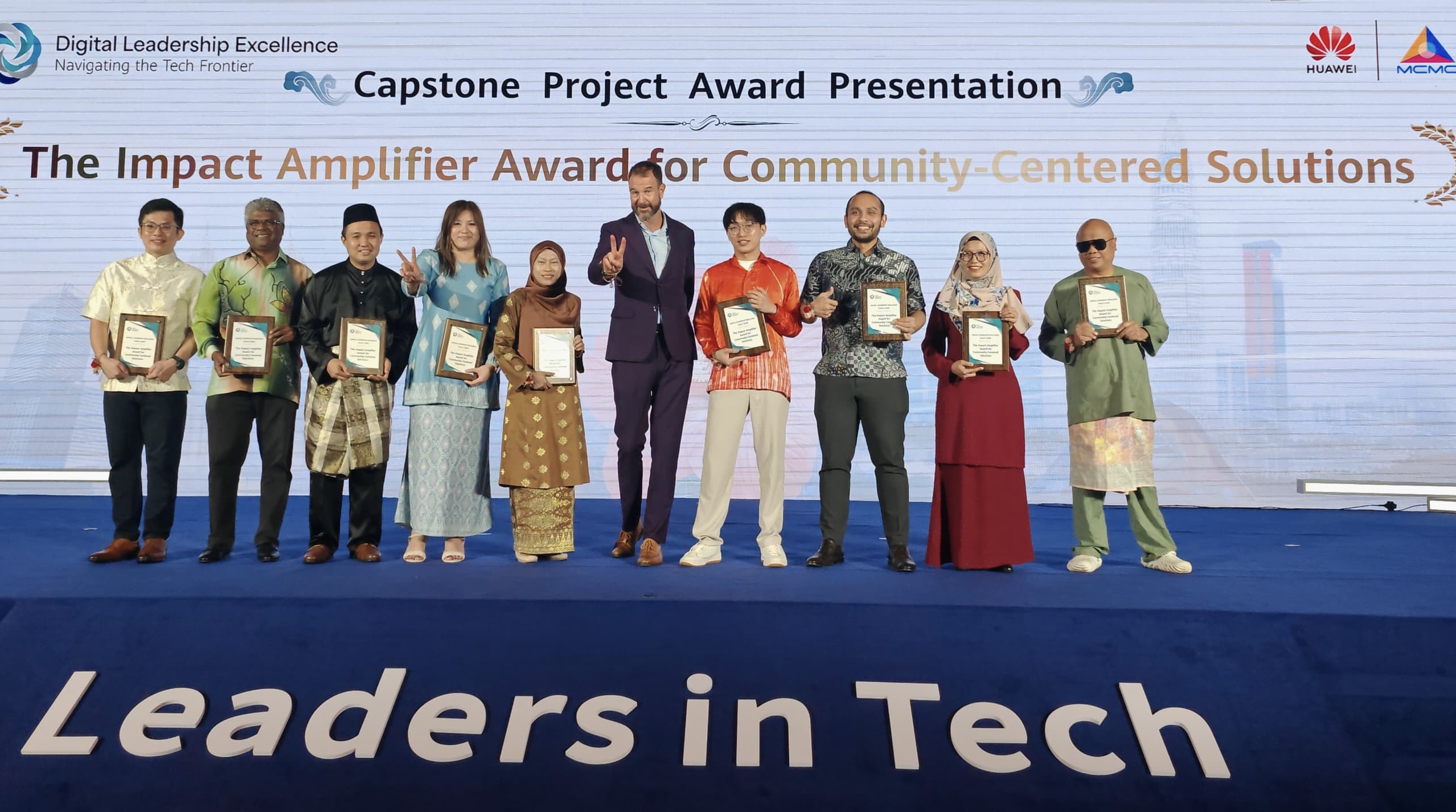
Dr Aun (fourth from right) with his teammates at the award ceremony
Faculty of Information and Communication Technology (FICT) academic Ts Dr Aun Yichiet, winner of the Impact Amplifier Award for Community-Centered Solutions, believes that everyone should have access to education and inclusivity, not only in areas where technology is driven by profit. He also emphasised that those who come from privileged backgrounds have a duty to serve the underprivileged. Guided by this belief, he and his team developed the EduBridge AI tutor solution, which runs on the edge, bringing world-class learning to those with limited connectivity.
He enthused, “We are truly honoured to have our effort recognised at the national level of the award. At UTAR, we’ve always challenged ourselves to turn new ideas into real impact, and with that foundation, we pitched not just technology, but a voice for the underserved. I believe that sincerity touched the judges, and I’m grateful to UTAR for providing the supportive platform that allowed us to focus on creativity and purpose.”
The award ceremony took place during the Digital Excellence Leadership (DLE) Capstone Presentation on 20 June 2025 at Shangri-La Hotel, Shenzhen, China. It was organised by the Malaysian Communications and Multimedia Commission (MCMC) and Huawei Malaysia.
The EduBridge AI: Bridging the Rural Education Divide with Offline, Voice-First AI is an offline, voice-first learning ecosystem designed to bridge Malaysia’s rural education divide, empowering 1.2M underserved students and 112K teachers. It delivers adaptive, multilingual lessons and teacher support even without stable internet, ensuring no child is left behind. The ecosystem combines AI tutors, virtual teaching assistants, and microlearning modules optimised for low-cost tablets. Dr Aun served as the Technology Officer, who contributed to the technical development and integration of the solution.
Dr Aun explained, “The project was inspired by real stories, like Aina in Kelantan, who dreams of becoming a doctor but lacks teachers and connectivity. It taught us that education access should not depend on infrastructure privilege. This is why EduBridge AI is built to run on RM300–500 tablets with SD/USB offline kits, supporting Bahasa, Tamil, Mandarin, and English. Teachers use its Virtual Teaching Assistant and microlearning modules to reduce workload and improve lesson continuity. We consider this an effort to uplift rural students by reducing exam failure rates, enabling equal access to digital learning, and easing teacher burnout. It contributes to inclusive national education goals under MyDIGITAL, JENDELA, and NIMP 2030, creating long-term social impact.”
He also pointed out that EduBridge AI is closely aligned with the United Nations Sustainable Development Goals (SDGs). It directly advances SDG 4: Quality Education, by ensuring inclusive and equitable access to learning through offline, multilingual AI tutors that reach rural students otherwise left behind. At the same time, it supports SDG 10: Reduced Inequalities, by bridging the digital divide and giving underserved communities equal opportunities to succeed academically. It also significantly contributes to SDG 9: Industry, Innovation and Infrastructure, through the deployment of edge AI and offline kits that deliver scalable, cost-effective educational infrastructure even in areas with limited connectivity. The project will also be featured in the upcoming Huawei DLE Capstone Report.
Dr Aun’s team members included:
• Adjunct Prof Rina Neoh - Secretary General, Ficus Capital / ESG Association of Malaysia (ESGAM)
• Dr Amir ‘Aatieff bin Amir Hussin - Head, Department of Computer Science, International Islamic University Malaysia
• Mr Muhamad Ezir bin Mohd Kushairi - Head of Business Enablement, Technology and Digital, Maybank Islamic
• Mr Rathakrishnan Arumugam – Director, EXPG Engineering Sdn Bhd (SME Association)
• Ms Yusnita binti Roslan - Senior Principal Assistant Secretary, Ministry of Education
• Mr James Chin - Head of Core Network, Time dotCom Berhad
• Mr Zakaria Polit - Head of Technology Services, Sarawak Digital Economy Corporation (SDEC)
• Ts Noraziah Suliman - Head, Geospatial Network Data Management and Coordination Department, Malaysian Communications and Multimedia Commission (MCMC)
• Mr Anuar M. Isa - Principal Engineer (Telecommunication), Petronas
The Digital Leadership Excellence (DLE) programme is a national initiative organised by Malaysian Communications and Multimedia Commission (MCMC) and Huawei Malaysia to train 300 future digital leaders of Malaysia through structured learning and a capstone project framework. The theme for this year was Navigating the Tech Frontier. It focused on 5G, AI, IoT, Cloud, Big Data, Green Technology, and Cybersecurity. Participants gain certificates and national recognition through capstone projects, industry immersion, and a formal graduation ceremony.
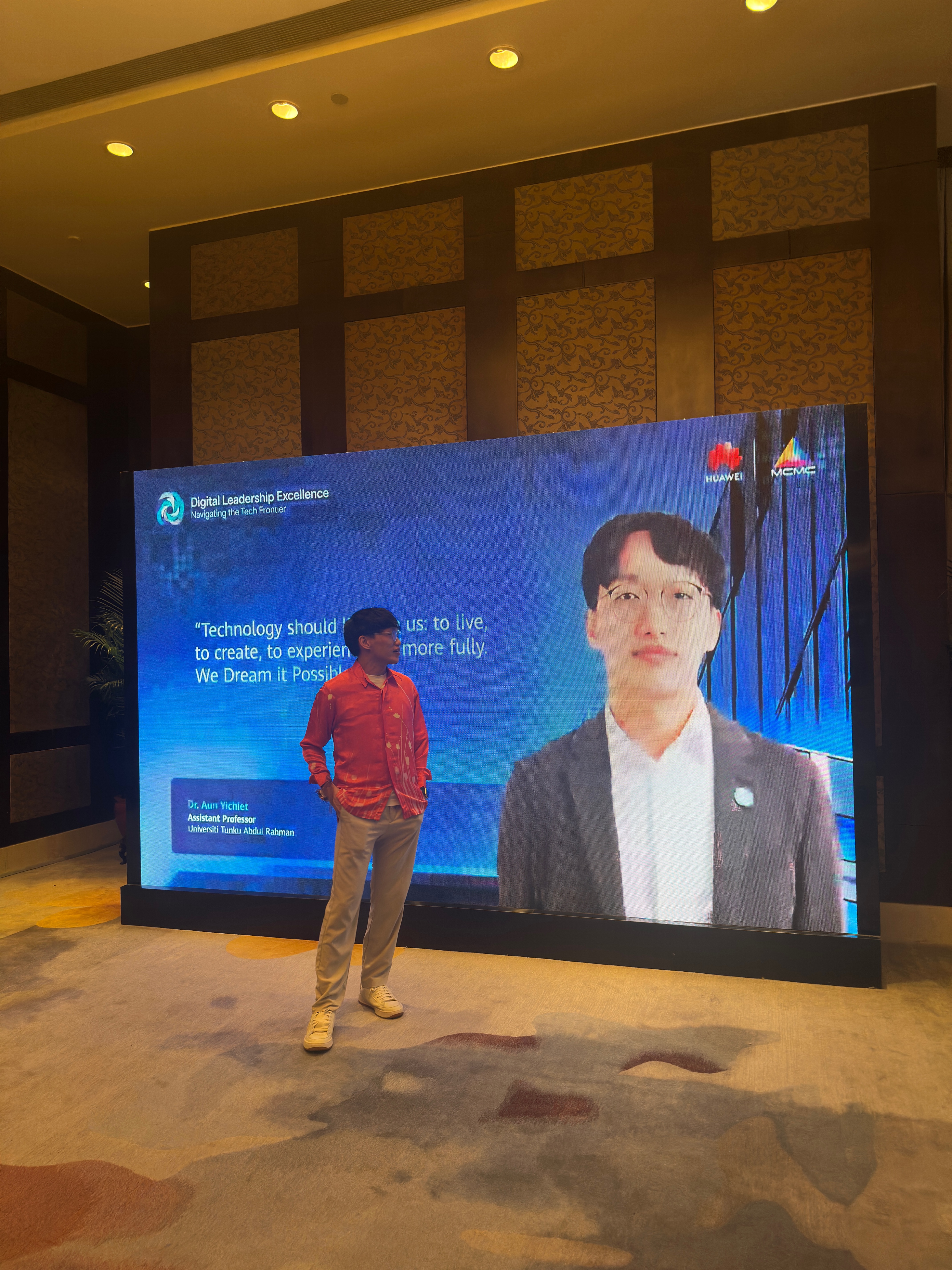
Dr Aun with his digital poster

Dr Aun (left) displaying his award at MCMC
© 2025 UNIVERSITI TUNKU ABDUL RAHMAN DU012(A).
Wholly owned by UTAR Education Foundation (200201010564(578227-M)) LEGAL STATEMENT TERM OF USAGE PRIVACY NOTICE