
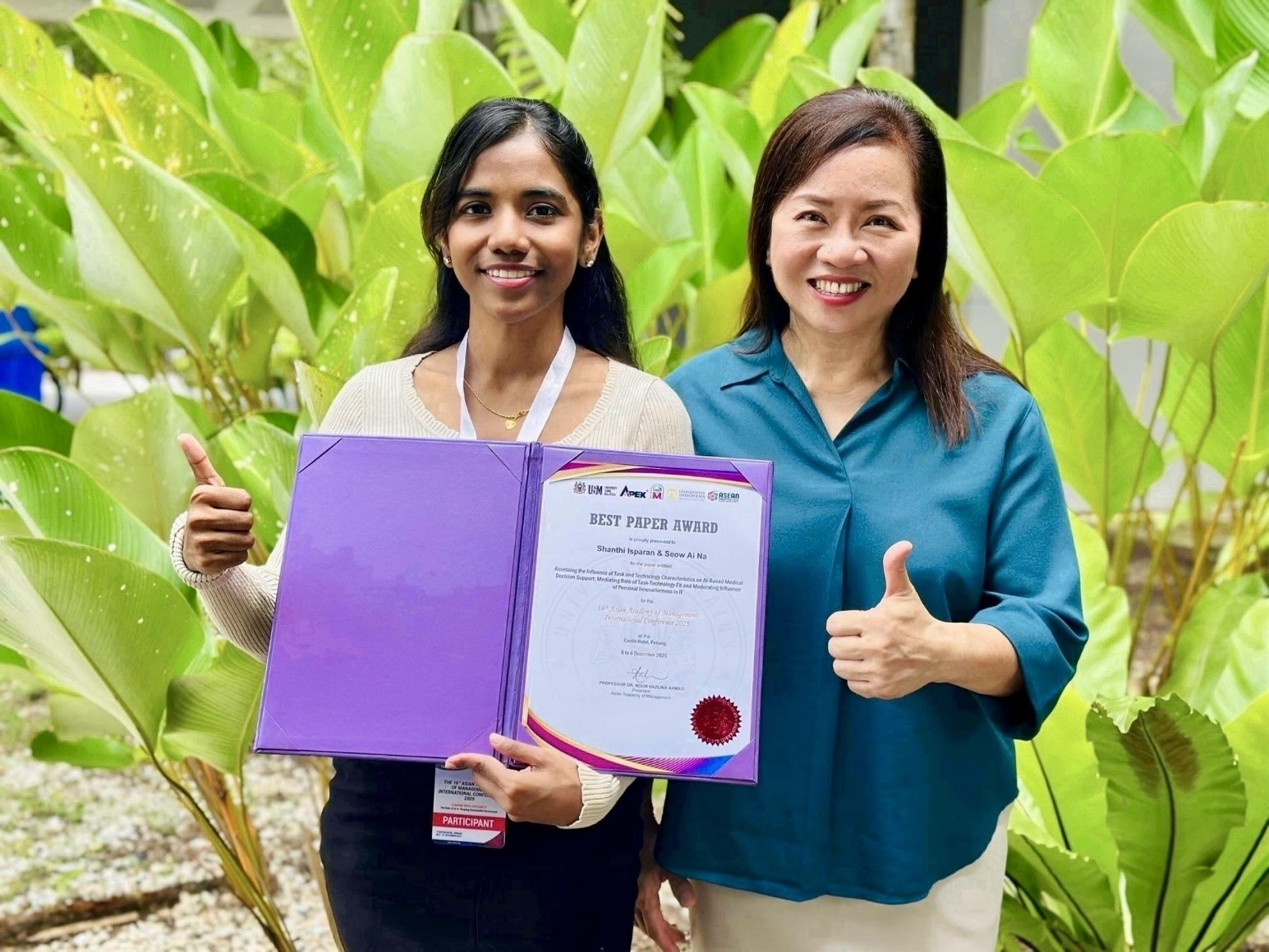
From left: Shanti and Dr Seow
With healthcare systems worldwide now integrating AI tools, strengthening credibility, usability, ethics, and effectiveness, this award-winning research stood out to emphasise one clear message: technology alone is not enough to transform healthcare; it also requires alignment, innovation, and responsible leadership.
The award-winning research is Assessing the Influence of Task and Technology Characteristics on AI-Based Medical Decision Support: Mediating Role of Task–Technology Fit and Moderating Influence of Personal Innovativeness in Information Technology. It was inspired by the rapid growth of Artificial Intelligence (AI) in Malaysian healthcare and the challenges associated with its acceptance among medical doctors. Although AI holds significant potential to improve diagnostic accuracy, streamline clinical workflows, and reduce doctors’ cognitive burden, many practitioners remain cautious about adopting AI-driven medical technologies.
As a research that could potentially reshape how AI supports medical professionals, it captured local and international attention when it received the Best Paper Award at the 16th Asian Academy of Management International Conference 2025 (AAMC 2025), organised by The Asian Academy of Management, from 5 to 6 December 2025, at the Eastin Hotel, Penang.
The authors, Doctor of Philosophy student Shanthi Isparan and Assoc Prof Dr Seow Ai Na from the Teh Hong Piow Faculty of Business and Finance (THP FBF), looked into Malaysia’s digital healthcare transformation and aimed to tackle a crucial challenge: ensuring that AI tools enhance clinical workflows.
Dr Seow enthused, “Joining this competition provided a valuable platform to showcase healthcare research and demonstrate how AI technologies can meaningfully support medical professionals. This recognition affirms both the academic rigour and practical relevance of the study, and motivates further pursuit of impactful, policy-relevant, and practice-oriented research in digital healthcare.”
Shanthi expressed, “Winning the Best Paper Award is a great honour and a meaningful validation of the effort invested in my research journey. I am deeply grateful to my supervisor, Dr Seow, and my co-supervisors for their continuous guidance and support throughout the research process. This achievement is closely linked to my experience at UTAR, where a strong research culture, supportive mentorship, and an emphasis on research excellence played a crucial role in shaping this study and contributing to its success.” They also received a cash prize of RM1,000 and a certificate.
Themed Leading with Integrity: The Role of AI in Shaping Sustainable Businesses, the 16th Asian Academy of Management International Conference 2025 (AAMC 2025) brought together brilliant scholars, passionate practitioners, policy leaders, and industry experts for two days of lively discussions, engaging sessions, meaningful networking, and deep reflections on the future of AI and integrity in business. The conference highlighted critical intersections of artificial intelligence, ethical leadership, and sustainable development.
Shanthi explained, “The project was further driven by Malaysia’s growing national focus on digital healthcare transformation, the Ministry of Health’s strong push toward AI-enabled solutions, and the critical need to ensure that these innovations genuinely improve doctors’ clinical workflows. It provides meaningful insights for healthcare organisations and technology developers. Enhancing technology characteristics such as usability, flexibility, and reliability directly improves AI-based medical decision-making. In Malaysia, AI is increasingly integrated into radiology, triage, and clinical decision support systems. Hospitals can optimise adoption by ensuring compatibility with platforms like MySejahtera Health Records, Teleprimary Care (TPC), and Electronic Medical Records (EMR) systems. Seamless integration reduces workflow disruptions, minimises duplicate data entry, and allows doctors to access AI insights within their existing interfaces.”
Dr Seow noted, “Improved AI-based decision-making enhances patient safety, diagnostic accuracy, and efficiency across the Malaysian healthcare system. Reducing cognitive load among doctors supports better job satisfaction and reduces burnout, contributing to a more sustainable healthcare workforce. A culture of innovation and responsible use of AI promotes public trust and ultimately improves patient outcomes nationwide.”
The research aligns with Sustainable Development Goal (SDG) 3: Good Health and Well-being. It supports the alignment of medical tasks with AI-based decision support systems to enhance clinical decision-making, improve accuracy, and improve patient outcomes. Another SDG aligned is SDG 9: Industry, Innovation, and Infrastructure, because it provides insights into the effective design and adoption of AI technologies, supporting user-centred and sustainable digital health innovation in healthcare organisations.
In a conference dedicated to integrity in AI-driven sustainability, Shanthi and Dr Seow’s work stands as a compelling example of research that bridges theory and practice. It also highlights UTAR’s commitment to fostering rigorous, high-impact doctoral research aligned with national digital transformation priorities and contributing meaningfully to global conversations on ethical AI adoption.
© 2026 UNIVERSITI TUNKU ABDUL RAHMAN DU012(A).
Wholly owned by UTAR Education Foundation (200201010564(578227-M)) LEGAL STATEMENT TERM OF USAGE PRIVACY NOTICE