
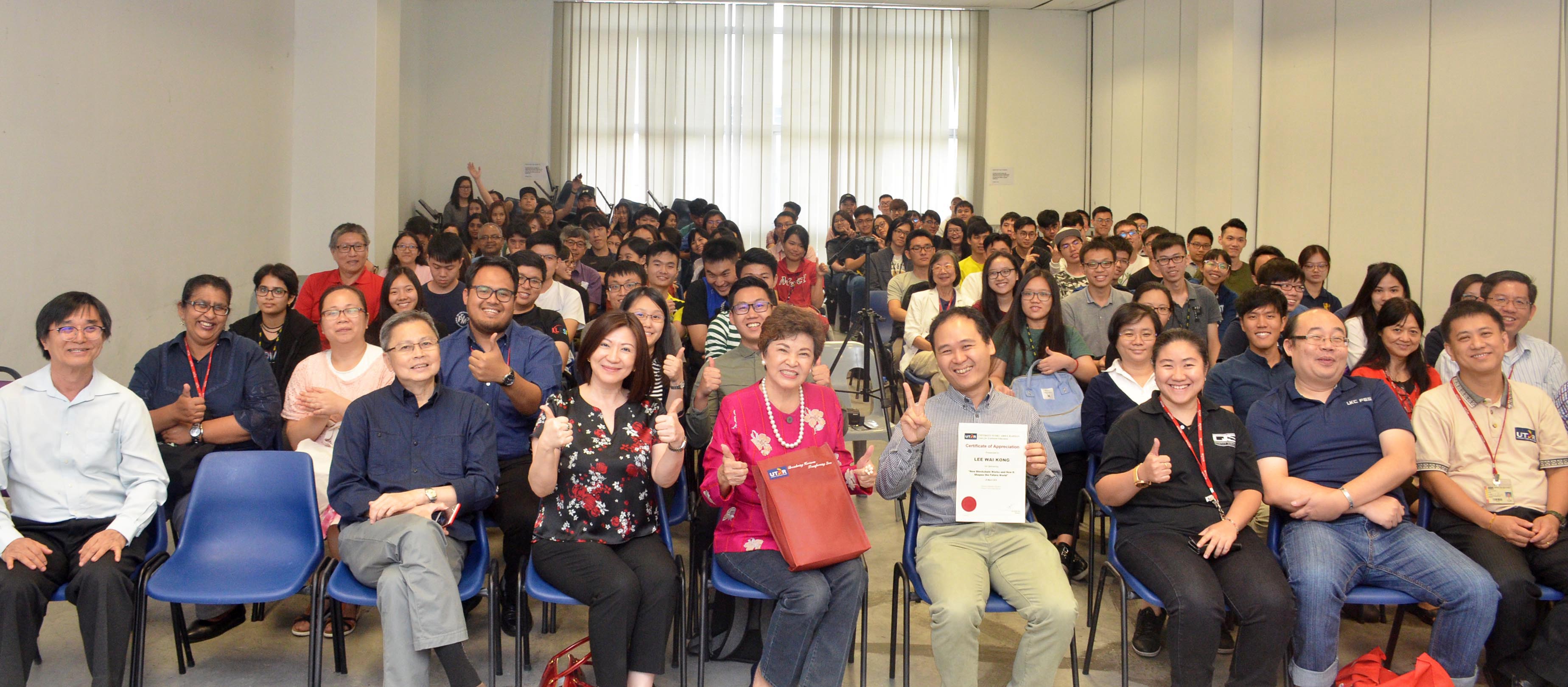
Group photo after the talk
More than 100 curious minds came to listen to “How blockchain works and how it shapes the future world” talk conducted by Centre for Extension Education (CEE) on 29 March 2018 at Sungai Long Campus.
Delivering the talk was a lecturer from Faculty of Information and Communication Technology Lee Wai Kong. Before joining UTAR, he was a firmware engineer in several multinational companies including Agilent Technologies and Xyratex Sdn. Bhd. His current research interests include cryptography, GPU computing energy and Internet of Things (IoT).
Present for the talk were YBhg Tan Sri Dato’ Sri Dr Ng Yen Yen, CEE Director Lim Guat Yen, students, staff and the public. Lee began the talk by explaining the origin of blockchain.
He said, “Blockchain started due to some problems we faced in our financial system. Firstly, we are often charged with transaction fee. Transactions that are made through credit card, cheque and bank deposit require one to three working days for it to be successful. This is because they need to take many fraud preventive steps to ensure the safety. In order to take all these precautions, you are charged with the transaction fee.”
Most of the time a trusted third party (TTP) is utilised, who will review transactions critically, making sure there is no misconduct. However, according to Lee, TTP is not always trustworthy as it is run by human. It is prone to errors and bad intention. For instance, the leak of personal details by an irresponsible entity. This is where blockchain system comes into play by replacing the TTP with a network of computers (called nodes) that join the blockchain system. Therefore, instead of having an external verifier, those inside the network will verify any transactions made.
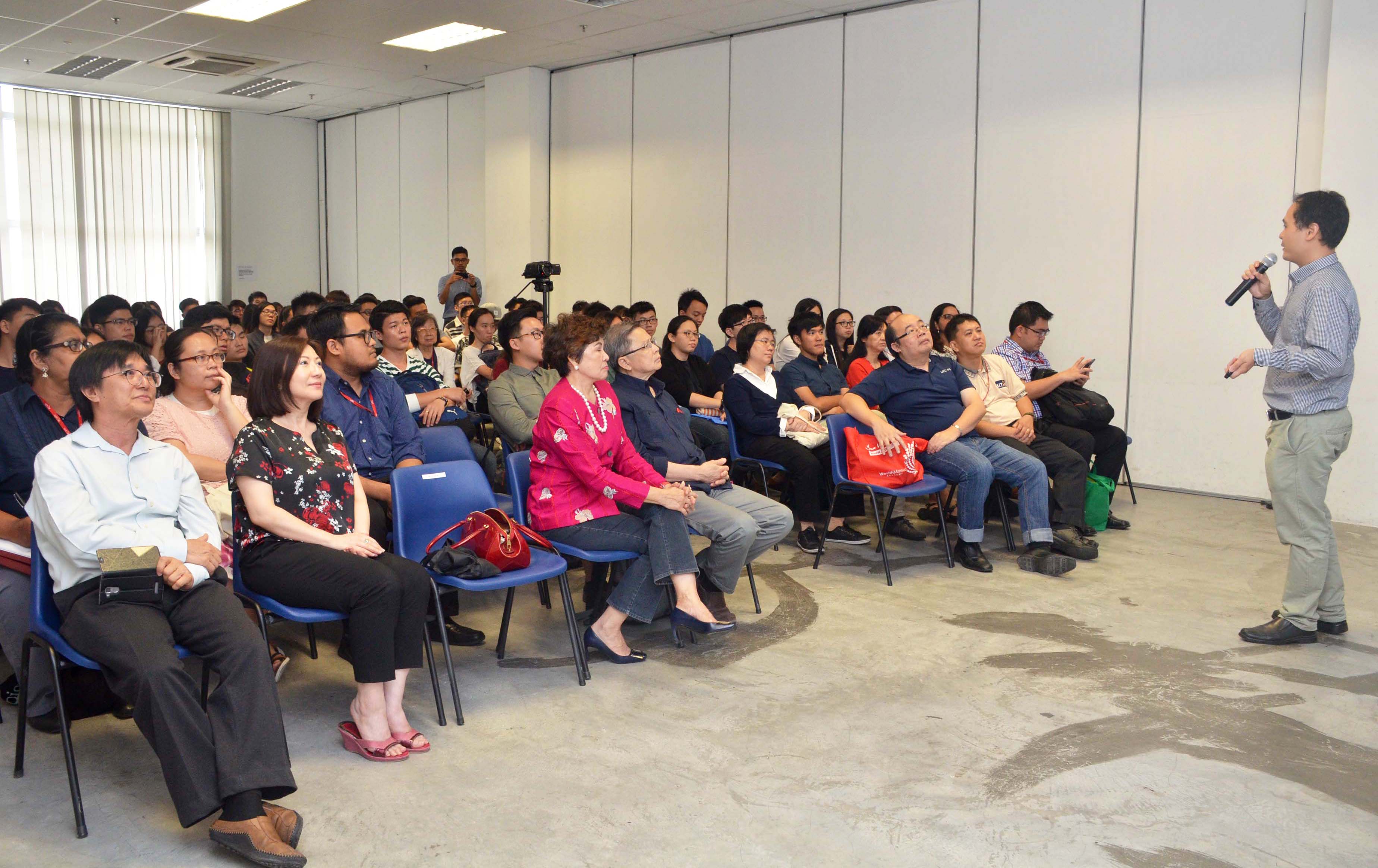
Lee and his attentive audiences
Lee also elaborated the conceptual process of how blockchain works. Named as per the process, blockchain consists of blocks, created to join to the chain of blocks that are already existing. The creation of the block is the important part, where “miners” mine for blockchain like how the Bitcoin works.
Every transaction made will require verification. The process to verify the transaction requires the “miners” to compile recent transactions into a block and solve a computational difficult puzzle.
“It’s like playing the lottery. You keep guessing until you win. You have to do a lot of computation in order to get the correct answer. The first entity that manages to solve the difficult puzzle will create a new block. The whole process is very computationally demanding and costly thus it requires an incentive, which is Bitcoin. Without the incentive no one would be interested to do the mining.”
The talk continued with the benefits of blockchain which included decentralizing system (P2P) where no single entity is able to overpower the rest, allowing the system to be free of superior control. Aside from that, transaction fee can be waived as the verification process is done among those in the system.
As something that is still new and emerging, blockchain also has its weaknesses. The transaction time of 10 to 20 minutes is considered very slow for the internet speed. A huge amount of memory is also needed to store data on every node. Lee also mentioned that a lot of energy is put to waste on useless calculations for Bitcoins mining, as it is a guessing game.
Blockchains that involve Bitcoin are public blockchains where everyone is allowed to join. Private blockchains, on the other hand, is controlled by an authority and only consist of registered nodes (not anonymous). In private blockchain, the consensus and incentive are not required.
As the technology improves, blockchain 2.0 now serves more than just about cryptocurrency. It is also called the Smart Contract where materials exchange can be done, thus opening up possibilities to many applications such as computer programs.
“Then we have the third generation of blockchain. There is no accurate definition of it yet. It could mean that different blockchains can interact with each other. For example, if you want to buy a medicine, the pharmacy can check your medical record from a different hospital blockchain system.”
Responding to a question in Q&A session, Lee explained that UTAR Blockchain Certification System is relevant as it will prevent certificates from being forged. He added, “Actually we do not need a blockchain to do this (certificate system). We can have a centralised server that everyone can access. However, this is fine if the centralised system does not have any problems, let’s say, for another 100 years. This is where blockchain has its value. The decentralised system will secure the recovery (i.e. the blockchain records) in case of server break down because it can be backed up from the nodes. Moreover, it is very difficult to create fake certificate as every issued certificate is “related” through a series of previous certificates through cryptographic hash function”.
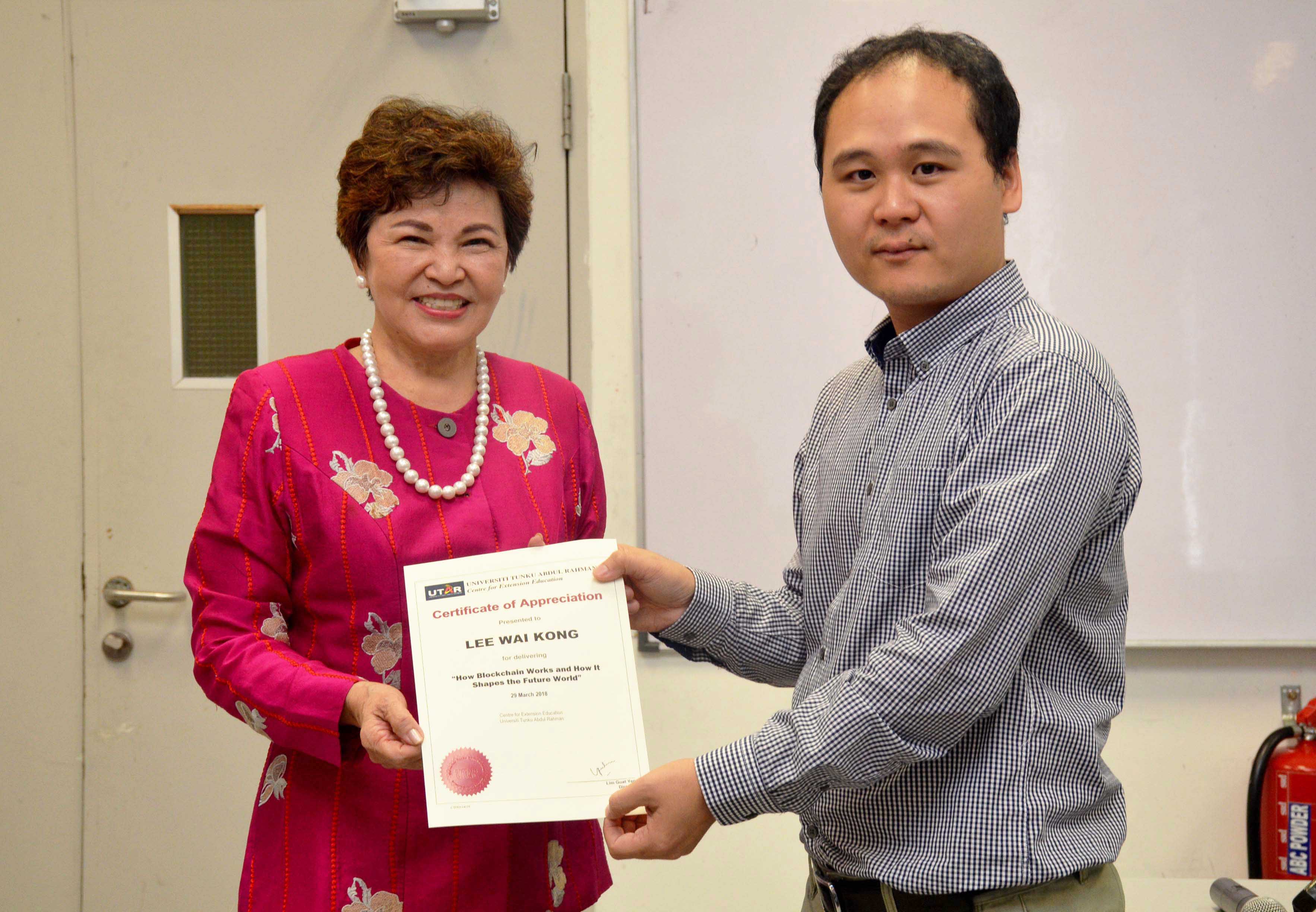
YBhg Tan Sri Ng presenting certificate of appreciation to Lee
© 2019 UNIVERSITI TUNKU ABDUL RAHMAN DU012(A).
Wholly owned by UTAR Education Foundation Co. No. 578227-M LEGAL STATEMENT TERM OF USAGE PRIVACY NOTICE