
The Centre for Accounting, Banking and Finance, Teh Hong Piow Faculty of Business and Finance (FBF), organised a webinar titled Enterprise Risk Management (ERM) on 10 September 2025 via Microsoft Teams. Led by Dr Dinesh Kumar Saundra Rajan, academic at THP FBF, the session engaged students and lecturers with practical insights into managing uncertainty in today’s volatile business landscape.
Dr Dinesh opened the session with a compelling analogy: “Why do cars need brakes? So we can drive faster with confidence.” He explained that ERM isn’t about stopping progress but about enabling organisations to pursue strategic goals boldly by managing risks proactively.
Dr Dinesh highlighted that ERM is a structured, consistent and continuous process which includes identifying risks (such as over-reliance on a single supplier), assessing their likelihood and impact, responding through mitigation or transfer (such as insurance), and continuously monitoring emerging threats like cyberattacks.
To illustrate, Dr Dinesh led an interactive risk assessment exercise using real campus scenarios. Participants evaluated situations such as “unable to find parking during final exams” versus “system outages,” plotting them on a frequency-severity matrix. The exercise revealed how ERM helps prioritise risks, turning a mundane issue like parking into a high-severity concern during exams, demonstrating that context influences risk perception and response.
Dr Dinesh outlined ERM’s key benefits, which include improved decision-making, enhanced cross-departmental risk visibility, regulatory compliance, business resilience, and long-term value creation. He commented that investors and customers trust organisations that manage risk transparently. He also addressed common implementation challenges, such as resistance to cultural change, lack of risk awareness (for instance, employees clicking phishing links), data silos across departments, and resource constraints. Yet, he stressed that these can be overcome with leadership buy-in and training.
The session then covered the five core components of an ERM framework, which consist of risk identification, assessment, response, monitoring, and communication, and introduced ISO 31000 as a globally recognised standard. During the Q&A, Dr Dinesh clarified how ERM differs from traditional risk management. While the latter operates in departmental silos, for example, finance handles financial risk and IT manages cyber risk, ERM takes a holistic, organisation-wide view that aligns risk strategy with business objectives.
In closing, Dr Dinesh urged participants to see ERM not as a compliance burden or theoretical exercise but as a mindset to build organisational confidence to adapt, innovate, and turn uncertainty into opportunity.
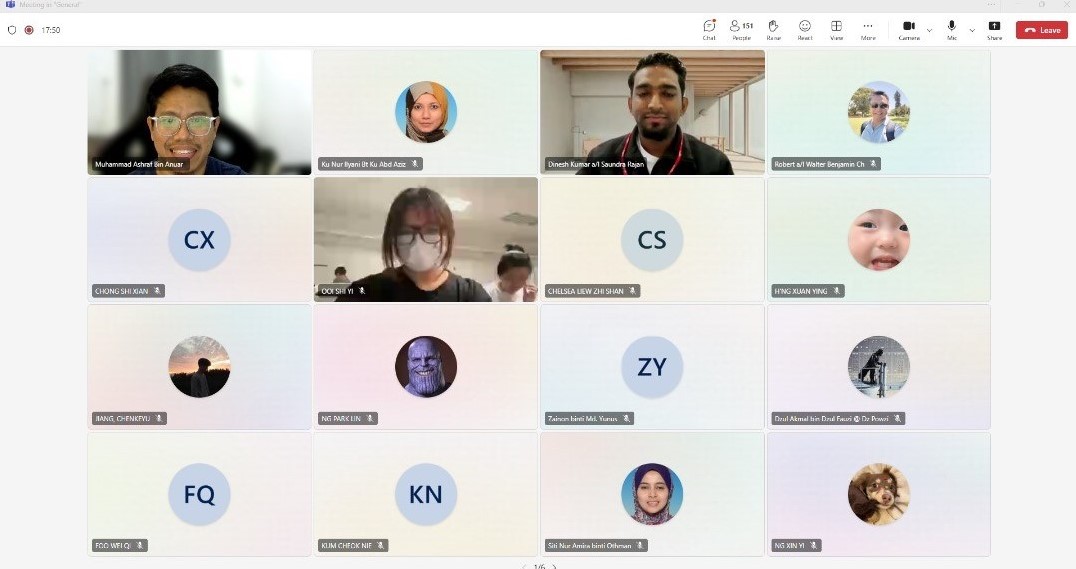
Dr Dinesh and the participants
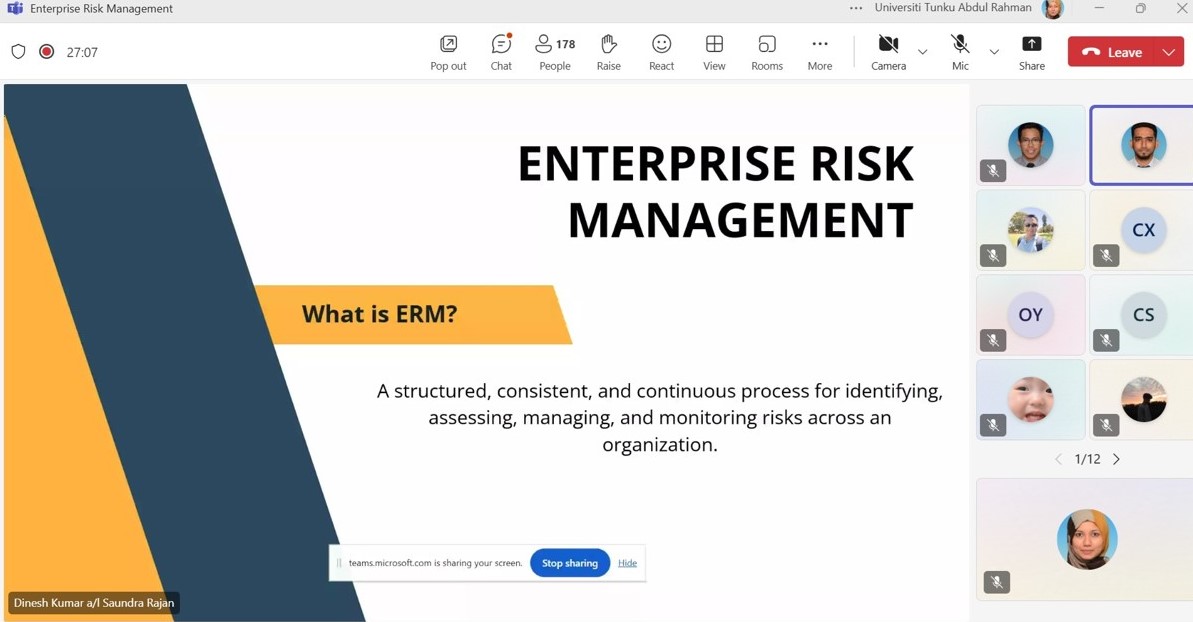
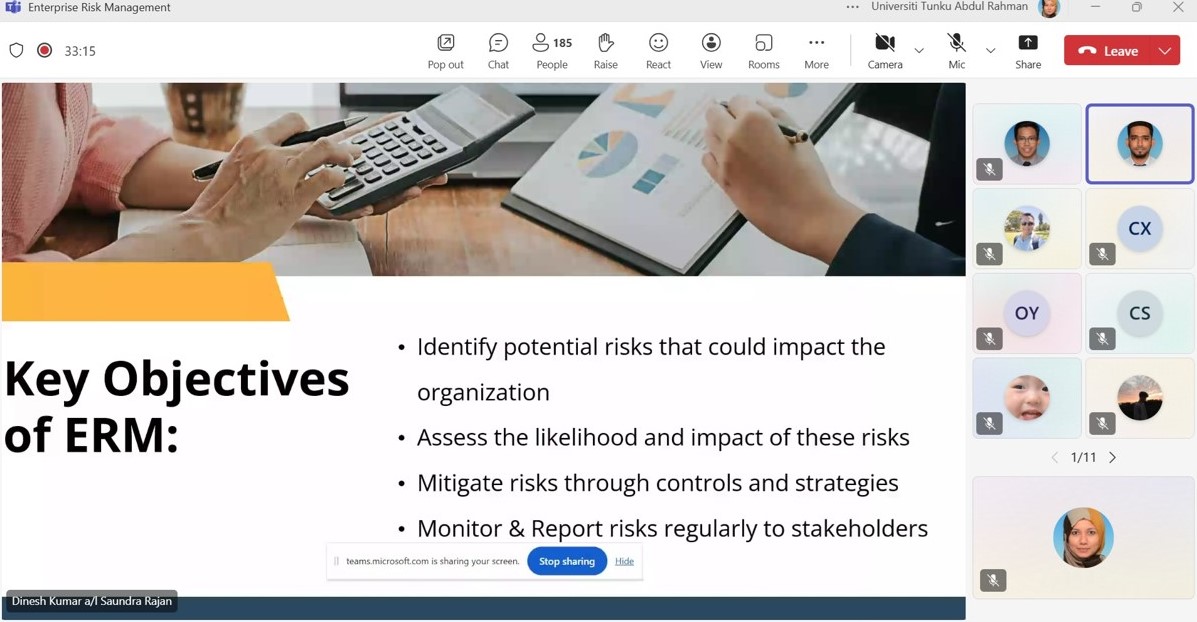
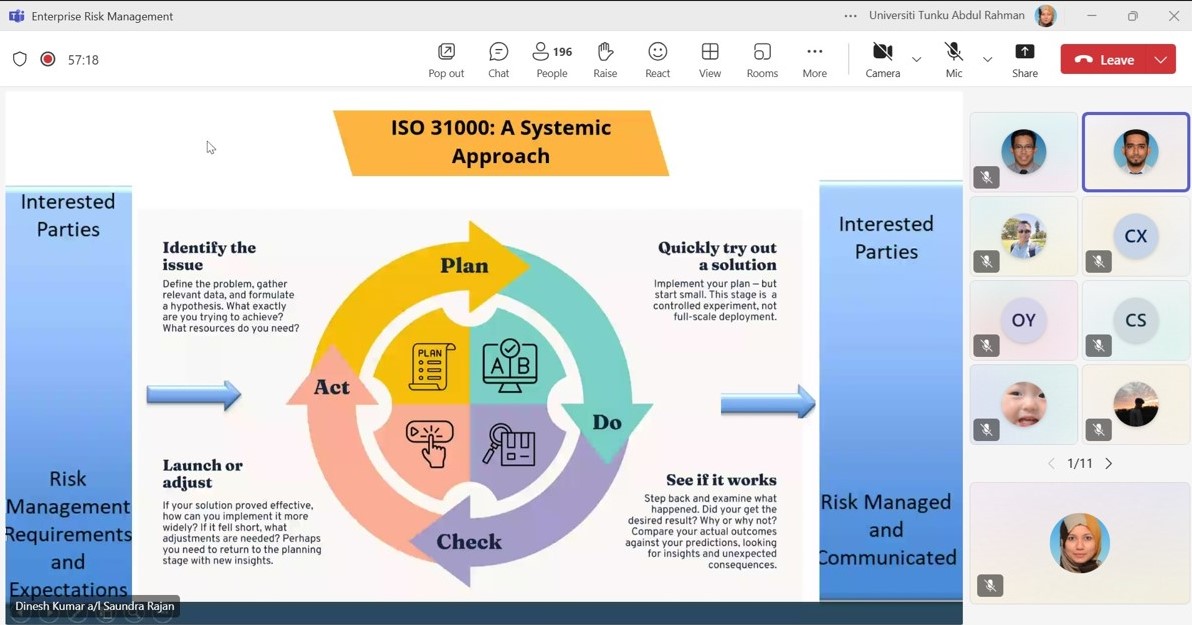
Some of the presentation slides during the webinar
© 2025 UNIVERSITI TUNKU ABDUL RAHMAN DU012(A).
Wholly owned by UTAR Education Foundation (200201010564(578227-M)) LEGAL STATEMENT TERM OF USAGE PRIVACY NOTICE